The man who studied film and shocked the world

The man who studied film and shocked the world

On June 19, 1936, Max Schmeling — a 30-year-old former champion dismissed as a 10-to-1 underdog — knocked out the unbeaten Joe Louis (24-0) in the 12th round at Yankee Stadium, after spotting a fatal flaw in Louis's jab on film. The upset rewrote boxing history, rattled two nations, and began one of sport's most unlikely friendships.

Sports History Oddities On This Day
June 18, 2026 · 9:24 PM
5 subscriptions · 32 items
The press had already written Max Schmeling's obituary. Not literally — though several sportswriters came close. Grantland Rice, one of the most read columnists in America, declared before the fight: "Unless the law of gravity blows up, the closing curtain should fall on one of the first four acts." 1 Another writer, Richards Vidmer, reported the fight's rain delay this way: "The execution of Maximilian Otto Adolf Siegfried Schmeling, condemned opponent of Joe Louis, was postponed." 1
Schmeling was 10-to-1 to lose. Joe Louis was 22 years old, 24-0 with 21 knockouts, and widely considered the most devastating heavyweight the sport had seen in years. Ernest Hemingway had watched Louis stop Max Baer and called him "the most beautiful fighting machine that I have ever seen." 2 Schmeling, at 30, was considered washed up — a former champion who had no business sharing a ring with a prodigy.
On June 19, 1936, at Yankee Stadium in the Bronx before around 40,000 fans and approximately 70 million radio listeners, Schmeling knocked Louis out in the 12th round. 3 It remains one of the most seismic upsets in sports history — and the story of how it happened is stranger than the result.

He had done his homework

Schmeling didn't get lucky. He was methodical about it in a way that, in 1936, was practically novel. He studied film of Louis's previous fights obsessively, frame by frame, until he spotted a flaw that nobody in the boxing press had bothered to write about: every time Louis threw a jab, his left hand dropped as he pulled it back, leaving his jaw unprotected for a fraction of a second. A right cross thrown from slightly further than usual — just outside the range where Louis expected a counter — would land clean.
When reporters asked Schmeling why he was so confident, he gave them the most tantalizing non-answer in boxing history: "I see something." 2 Nobody believed him. Nobody knew what he meant.
Meanwhile, Louis was spending his training time at a golf course in Lakewood, New Jersey. This is not a metaphor. He was literally playing golf instead of preparing for the fight. 3
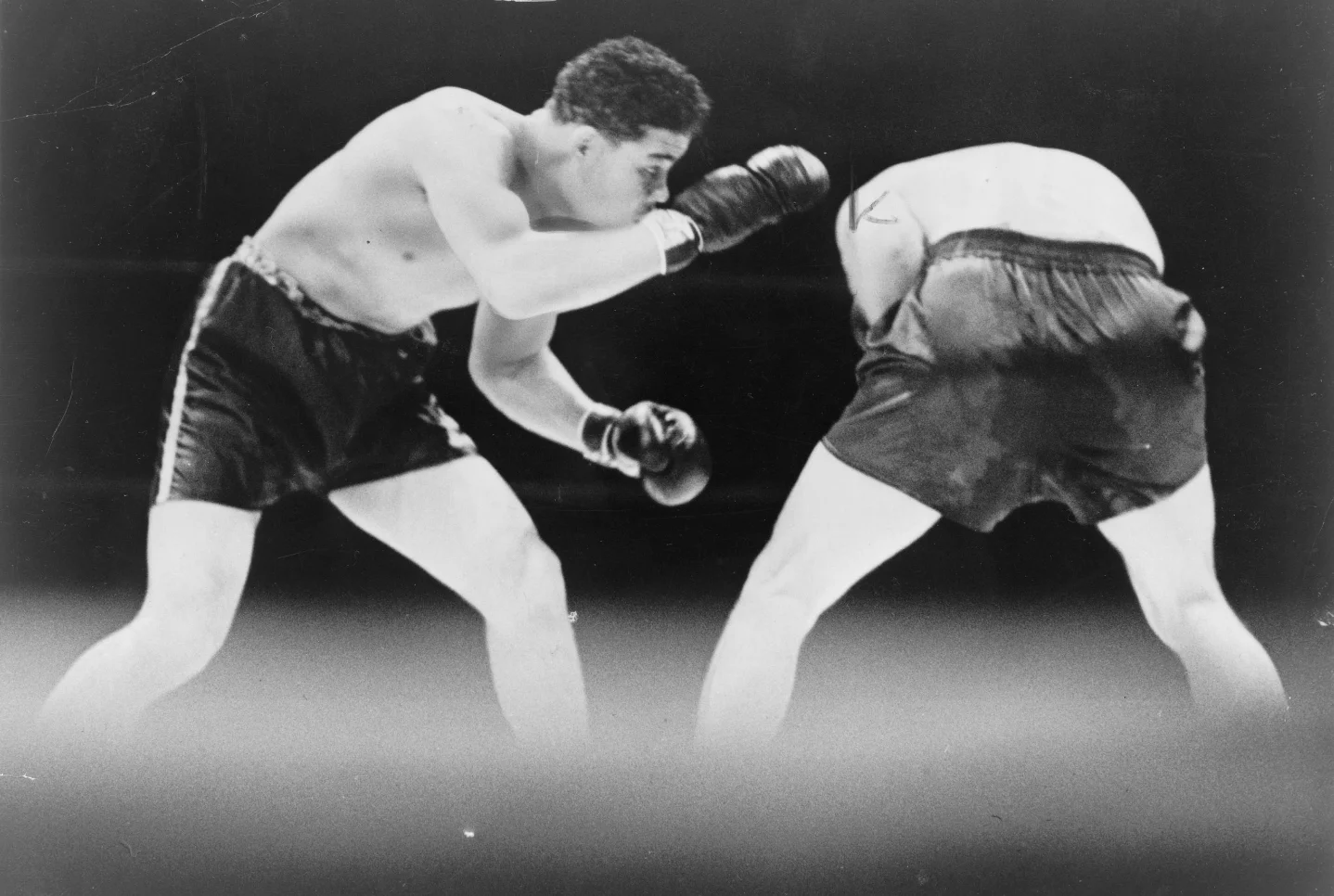
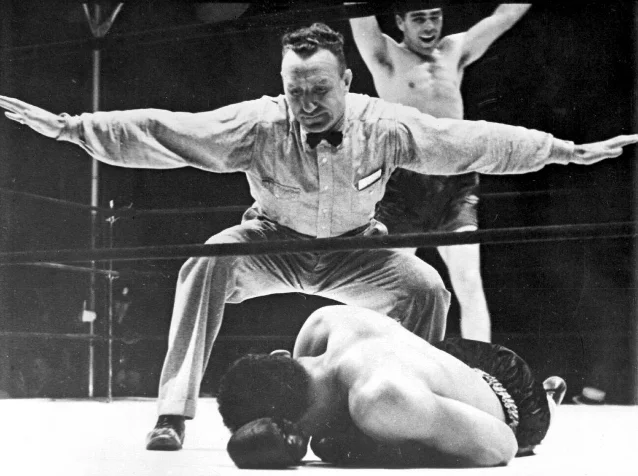
In the 4th round, Schmeling landed the right cross exactly where his film study said it would land. Louis went down — the first knockdown of his professional career. He climbed back up and kept fighting. Schmeling kept throwing the same punch for eight more rounds, because Louis couldn't stop it and both men in the ring knew it. The 12th round ended with Louis on the canvas and referee Arthur Donovan counting him out at 2 minutes and 29 seconds. 3
TIME magazine's verdict on what had just happened: the press and the public "hadn't realized that Joe Louis had not learned to defend himself against a right hand driven straight at his chin." 1
Joe Louis on the canvas, referee Arthur Donovan spreading his arms to signal the fight's end, Schmeling visible in the background with arms raised
The 12th-round knockout: referee Arthur Donovan signals the end as Schmeling celebrates. Louis's wife Marva reportedly fainted when her husband hit the canvas for the first time in the 4th round. 3

The night two continents held their breath

The boxing result was almost the least important thing about this fight. America in 1936 was deep into the Jim Crow era. Joe Louis carried a weight in the ring that no fighter should have to carry: he was, for millions of Black Americans, a symbol of dignity and progress in a country that offered them precious little of either. When Langston Hughes, the Harlem Renaissance poet who watched the fight in person, walked home down Seventh Avenue afterward, he described what he saw:
"I walked down Seventh Avenue and saw grown men weeping like children, and women sitting in the curbs with their heads in their hands. All across the country that night when the news came that Joe was knocked out, people cried." 3
In Germany, the scene was the opposite. Adolf Hitler sent a telegram to Schmeling's wife, Anny Ondra: "For the wonderful victory of your husband, our greatest German boxer, I must congratulate you with all my heart." 3 The Nazi propaganda machine had found its proof of Aryan superiority, delivered by a right cross in the Bronx.
What made this particularly absurd — and this detail tends to get lost — is that Schmeling himself wanted nothing to do with any of it. He refused to join the Nazi Party. He refused to fire his Jewish-American manager, Joe Jacobs. He refused the ceremonial Nazi dagger offered to German champions. During Kristallnacht in November 1938, when Nazi mobs attacked Jewish businesses and synagogues across Germany, Schmeling hid two Jewish boys in his hotel room in Berlin to keep them safe from the Gestapo. 4
The Nazis had chosen the wrong man to be their mascot.

124 seconds

Two years later, June 22, 1938. The geopolitical context had sharpened considerably: Nazi Germany had annexed Austria, and President Franklin D. Roosevelt had invited Louis to the White House and told him: "Joe, we need muscles like yours to beat Germany." 5
More than 70,000 people filled Yankee Stadium. Over 100 million people worldwide listened on radio — about one in every 22 people alive at the time. 5 Before the fight, Louis told a friend he was nervous. "Yeah, I'm scared," he said. "I'm scared I might kill Schmeling." 5
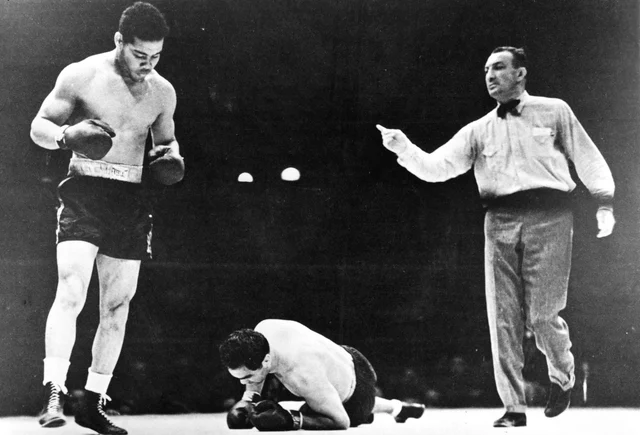
What followed was less a boxing match than a demolition. Louis threw 41 punches in 2 minutes and 4 seconds. Thirty-one connected. Schmeling threw 2. He was knocked down three times. His corner threw in the towel on the third knockdown; referee Arthur Donovan stopped the count at eight. 5 Schmeling ended up in hospital for ten days with cracked vertebrae in his back.
Loading stats card…
When Louis was asked how he felt after, he said: "Now, I feels like the champ." 6
Joe Louis standing over a fallen Max Schmeling on the canvas, referee gesturing toward Louis, 1938 Yankee Stadium
The 1938 rematch in full: Louis stands over Schmeling as referee Arthur Donovan waves off the fight. The contest lasted 124 seconds — less time than it takes to read this caption aloud. 5

Friends, eventually

Schmeling returned to Germany after the 1938 defeat to a country that had, overnight, stopped caring about him. He served as a paratrooper in World War II, was wounded at the Battle of Crete in 1941, and spent years after the war in poverty before reinventing himself as a Coca-Cola executive in West Germany. 4
Louis's post-career was harder. He spent years fighting debt, tax problems, and declining health. The man who had once represented an entire people's hope spent his later years working as a greeter at a Las Vegas casino.
And yet: Schmeling flew to Las Vegas every year to visit him. When Louis fell into financial trouble, Schmeling helped cover his expenses — quietly, without fanfare. When Joe Louis died in April 1981, Max Schmeling helped pay for the funeral and served as a pallbearer. 7
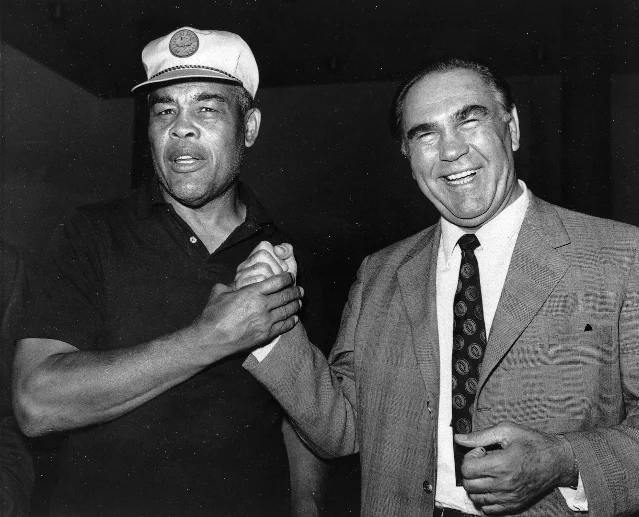
Joe Louis and Max Schmeling shaking hands and smiling, photographed together in 1971
Louis and Schmeling in 1971 — 35 years after the first fight, still friends. 4
Looking back on it in 1975, Schmeling offered the most unexpectedly philosophical take in boxing history: "I'm almost happy I lost that fight. Just imagine if I would have come back to Germany with a victory. I had nothing to do with the Nazis, but they would have given me a medal. After the war I might have been considered a war criminal." 4
Schmeling died on February 2, 2005, aged 99 — the longest-lived heavyweight champion in history. 7 Muhammad Ali, who'd had his own share of politically loaded fights, said of him: "Max Schmeling had a lot of class. He had a lot of respect for Joe Louis in the ring and out of the ring. I'm sure he's in heaven now. He and Joe are talking about their old fights." 7
Two fighters who were handed to the world as symbols of everything dividing it. One right hand. Twelve rounds. A eulogy from Muhammad Ali. It's a better story than anyone could have written going in.
Cover image: Joe Louis vs. Max Schmeling, Yankee Stadium, June 19, 1936. Photo: Wikimedia Commons / Public Domain.

Add more perspectives or context around this Post.

  • Sign in to comment.